Wednesday, November 20, 2019

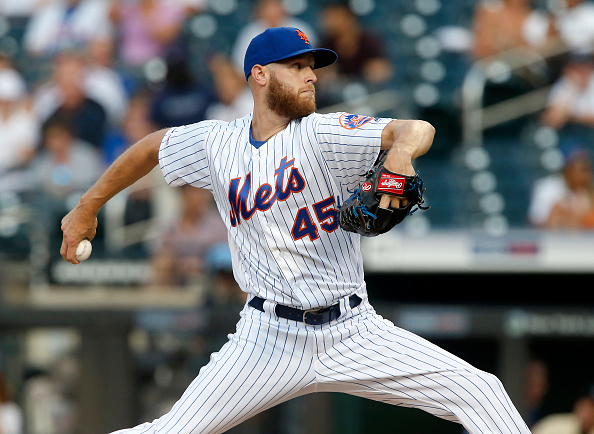
Zach Wheeler - Future Jay ?


Following two fairly tame winters in terms of activity, this one should be a different story for the Toronto Blue Jays. So over the next few weeks, we’ll be identifying and assessing players around Major League Baseball — both free agents and potential trade targets — who we think might currently find their name on some of those infamous Blue Jays whiteboards, as the front office looks to improve the club heading into the 2020 season.

Next up, free-agent starting pitcher Zack Wheeler.


Zack Wheeler, the big, hard-throwing right-hander, has overcome prolonged injury issues to prove he can be an effective front of the rotation starter. After declining the $17.8 million qualifying offer from the New York Mets, the 29-year-old is a free agent for the first time and is expected to receive a big pay raise following the two best seasons of his career.
Originally drafted sixth overall by the San Francisco Giants in 2009, Wheeler spent a season and a half pitching in the Giants’ minor league system before he was traded to the Mets in 2011 for Carlos Beltran. Two seasons later, he was among the top prospects in baseball. He debuted in June 2013, throwing six shutout innings against Atlanta and went on throw 100 innings in his rookie year with the Mets.
In 2014, his first full season in the majors, Wheeler showed promise as a future ace. In 32 starts, he had a 3.54 ERA with 187 strikeouts in 185 1/3 innings. But the following March, Wheeler underwent Tommy John surgery after he tore his ulnar collateral ligament. He missed the entire 2015 and 2016 seasons recovering. Wheeler returned to the majors in 2017 but would continue to deal with injuries in his right arm, pitching only 86 1/3 innings before he was shut down.
By spring training of 2018, Wheeler was finally healthy. He started the season in Triple A but was recalled by mid-April and went on to have a career season, going 12-7 with a 3.31 ERA in 29 starts. He remained healthy in 2019 and over the last two seasons, Wheeler has started 60 games, averaging a 3.65 ERA across 377 2/3 innings with a 3.37 FIP and 1.194 WHIP.
Since he rejected a qualifying offer, Wheeler will have draft pick compensation tied to his signing. Recent history suggests that could make teams wary of acquiring him. But with many clubs in need of starters, Wheeler should still attract suitors.

Wheeler’s 2019 in review:
Following a career-best season in 2018, Wheeler entered 2019 — his walk year — looking to put together another productive and, most importantly, healthy campaign. But he got off to a bad start, allowing 20 earned runs in his first six starts for a 5.05 ERA. By July 7, he had only lowered it to 4.69 through 119 innings.
Despite his poor performance, his name circulated in rumours ahead of the trade deadline as the Mets considered what direction — buying or selling — to take. During the height of speculation, Wheeler landed on the injured list with shoulder fatigue, lowering his chances of being dealt. (The Mets also reportedly had a high asking price).
Ultimately, Wheeler remained with the Mets. After 10 days on the IL, he returned with a rested shoulder and his performance improved through the second half. After a strong August, his best month was September, where he posted a 1.85 ERA in five starts. Overall, his second-half ERA of 2.83 was significantly better than the 4.69 ERA he put up in the first half. Wheeler finished the season with a 3.96 ERA, a 3.48 FIP and a 1.259 WHIP. He also threw a career-high 195 1/3 innings.
Following the season, it was an easy decision for the Mets to make Wheeler a qualifying offer; it guaranteed the club would at least receive a draft pick if he declined and signed elsewhere. Meanwhile, as Tim Britton of the Athletic, it was also a no-brainer for Wheeler to reject the offer to explore free agency, where he can seek a multi-year deal with an average annual value close to or above $17.8 million.


How is Wheeler trending?

It’s no secret Wheeler has a nasty fastball, but recently, he’s been throwing it even harder. This season, his four-seam fastball topped out at a career-best 100.59 miles per hour, while it averaged 97 mph, up about half a mile from last year, per Brooks Baseball. Of qualified starters in 2019, Wheeler’s average fastball velocity ranked fourth — behind Mets teammates Noah Syndergaard (1) and Jacob deGrom (3) and fellow free agent Gerrit Cole (2). Over the last two seasons, Wheeler has also increased the average velocity on his slider (91 mph) and his curveball (80 mph).
The right-hander has also significantly improved the command of his pitches over the last two years, lowering his walk rate from 10.4 percent in 2017 to 6.0 percent this season. His 2.30 walks per nine was also a career-best and nearly one walk less than the major-league average (3.29). Meanwhile, his strikeout rate of 23.6 percent was better than the league average, too.
Wheeler has done well limiting the home-run ball, although that’s partly because he pitches half his games at the pitcher-friendly Citi Field. Still, his 1.01 home runs per nine ranked eighth lowest in the National League, sandwiched between Walker Buehler and Steven Strasburg. His very good HR/FB ratio of 10.9 percent ranked third. Overall, Wheeler manages to limit hard contact very well. According to Statcast, his average exit velocity of 86.2 mph is in the 90th percentile league-wide, while his hard-hit rate of 32.2 percent is in the 82nd percentile.
While injury concerns may linger with Wheeler, given his history, over his last two healthy seasons, he’s been worth 8.9 WAR, per FanGraphs, which would rank him as the ninth-best pitcher in the majors over that same span.


Why Wheeler is a fit for the Blue Jays:
So, the obvious: The Blue Jays are in the market for starting pitchers, and Wheeler is a very good starter available this winter.
He won’t come cheap, but based on several projections, he also won’t demand the kind of money or term Gerrit Cole or Steven Strasburg will. In other words, if the Blue Jays are reluctant to hand over the amount it will take to sign either of those aces, perhaps Wheeler is in their price range. With just $38.4 million devoted to guaranteed salaries for next season, the Blue Jays have the room to spend and potentially outbid other teams. Blue Jays GM Ross Atkins has talked about their “financial flexibility” this offseason — but it’s only an advantage if they use it.

The Blue Jays are in search of starters that can “contribute in significant ways” and over the last two seasons, Wheeler proved he can be a dependable and successful starter. (Yes, the history of arm issues may be a red flag, but at this point, it should be a small one and the team would review his medical records before investing in him.) A healthy Wheeler has an arsenal that stacks up with the upper echelon of the league, and he would represent a significant upgrade to the team’s current rotation. At 29, he’s in the prime of his career and should remain at the top of his game for a few years to come, lining up with the Blue Jays’ potential timeline of contention in 2021 and beyond.

Why Wheeler might not be a fit for the Blue Jays:
If the Mets make Wheeler an offer he likes, he may opt to stay with the club he’s familiar with. “Honestly, I hate change,” Wheeler also told Marc Carig before the trade deadline. “I’m a homebody. I like the group of guys we’ve got here.”

Granted, choosing to sign a contract in the offseason is different from being uprooted from your home in the midst of the season. The fact Wheeler didn’t want to be traded midseason doesn’t mean he won’t sign elsewhere this winter if it’s best for his career. All we’re saying is the self-described “homebody” might be interested in remaining in Queens — especially if it means being part of a rotation that includes reigning Cy Young winner deGrom, Syndergaard and Marcus Stroman.
Even if the Mets decide not to pursue him, it’s fair to assume the Blue Jays will be competing against other teams to win over Wheeler. And selling a free agent on a rebuilding situation is always a tough task, especially when others can provide more competitive atmospheres.
With Wheeler linked to draft pick compensation, it would cost the Blue Jays their second-highest pick in the 2020 draft, plus $500,000 from their international bonus pool, to sign him. While Atkins has said publicly that surrendering a draft pick wouldn’t deter the team from signing a player, it’s an element that will have to be factored into the cost of acquiring Wheeler.

The likely competition:
There are a lot of teams in the market for starting pitchers this season. As one of the best options out there, Wheeler will be highly sought after. The teams appearing willing to spend include: the Phillies, Braves, Brewers, Cubs, Giants, Dodgers, Mets, Padres, Yankees, White Sox, Rangers, Angels and Astros.
Jim Bowden suggests  the Mets, Phillies, Brewers or Angels as potential landing spots for Wheeler.

Dollars and Sense:

Wheeler declined a $17.8 million qualifying offer from the Mets, so he’ll presumably be seeking a multi-year deal, likely with an average annual value in the range of $18-20 million.
MLB Trade Rumours  they predicted Wheeler could receive a five-year deal, worth $100 million. Fan Graph's predicts a four-year contract worth $72 million for an average annual value of $18 million. Meanwhile the Athletic guessed Wheeler could earn a $74 million, four-year deal with an AAV of $18.5 million.

In conclusion:

The Blue Jays have vowed to be aggressive this winter in pursuit of starting pitching. While they may not be players for guys like Cole or Strasburg, the Blue Jays have the financial means to go after a guy like Wheeler, who overcame injuries early in his career to finally look like the star pitcher many predicted he would be.
In the past, we’ve seen the Blue Jays make moves to raise the team’s floor — but adding a starter of Wheeler’s ilk would raise the ceiling. If the team is intent on competing in the American League East by 2021, they need to make moves that bolster their young position player core. A pitcher of Wheeler’s calibre would do that.
But the Blue Jays aren’t alone in their need for front-of-the-rotation arms and there will be other teams in the mix for Wheeler’s services, including his former team, the Mets. Wheeler will cost a draft pick plus a significant investment in terms of dollars and term. The Blue Jays have the financial flexibility to accommodate Wheeler but even if they decide to use it, will it be enough to lure Wheeler north?

Monday, November 18, 2019

Larger than Life


The ESPN personality formerly known as the Most Hated Man in Sports Media has become something altogether new: a star we can agree on.

Last week, Stephen A. Smith won two debates. The first Smith won in a rout. The $ 8 million a year contract he got from ESPN is proof that he’s the most important employee at the network, if not all of sports TV. “I consider me the American Dream,” Smith tweeted.

Smith won the second debate by virtual forfeit. . But there was almost no backlash to Smith’s contract. For a guy who was once the most polarizing man on sports TV, reactions to Smith now land somewhere between wary admiration and full-blown love. There’s a political term for that kind of turnaround. America has Strange New Respect for Stephen A.
To understand how wild this is, go back to 2005. Smith was a Philadelphia Inquirer columnist who’d just landed his first ESPN show. It was the time of the first great Stephen A. panic. A dozen think pieces asked: “Is this man the future of sports media?!”

Some of the panic was straightforwardly racial. The New York Post’s Phil Mushnick accused Smith of speaking to “urban street blacks or white street wannabes.” Another part emerged from the way Smith seemed to be bidding goodbye to the age of newspapers. He thumbed out on his Philadelphia Inquirer on a Blackberry(a crime in 2005, a skill a few years later). He had no interest in reproducing newspaper gentility on TV. Sports Illustrated called Smith’s rise “the final triumph of bluster and confidence over content, of point of view over facts, of opinion over objectivity.” Years later, a Hartford Courant writer sighed: “We are not Red Smith. We are Stephen A. Smith.”


For a guy who was supposedly reshaping the profession in his own image, Smith took a long time to achieve liftoff. His first show, Quite Frankly, was canceled. In 2009, ESPN decided to not renew Smith’s contract; two years later, the network brought him back. Smith didn’t become a true soloist until 2016, when Skip Bayless left ESPN for FS1. Smith rejiggered First Take around his own obsessions  and, with Max Kellerman, thumped Bayless in the ratings. According to media writer Michael McCarthy, Bayless is now entertaining the idea of a reunion.

As the new king of ESPN, Smith is the same opinionator he always was. We’re only five years removed from Smith suggesting, after Ray Rice’s arrest, that victims of domestic violence shouldn’t “provoke” their abusers. Last December, he predicted that a key matchup in an NFL game would involve a tight end who was out for the season and a linebacker who was out of the league.

These days, Smith powers through such gaffes and the inevitable tweets they produce. Barry Petchesky, who has plenty of unqueasiness, wrote about the pleasures of listening to one of his rants. Last year, Vinson Cunningham profiled Smith in The New Yorker.

How Smith became near bulletproof is fascinating. Part of it is the normal process that happens when TV people get famous, and reporters swap out engagement with their work for ratings reports and contract updates.

But this undersells how good Smith is at the performative parts of opinion TV. We focus on him when he’s in high rant mode, but watch the divinely sheepish the way he took his lumps from Marcus Spears after LSU beat Alabama. Way back in 2005, The New York Times’ Richard Sandomir noted that Smith was at his most watchable when he wasn’t speaking, when he wore a sly smile or skeptical frown. Smith explained then: “Somebody is saying something I don’t agree with and I have 45 seconds. I’m like, ‘Damn it, can I fit it all in?’”

The idea that Smith was crowding out “respectable” sportswriters—an idea revived during the ESPN layoffs—has more or less vanished. When I talk to ESPN reporters—the ones who still have jobs—they’re pretty Zen about the idea that First Take and other shows were subsidizing their work. After the gutting of shops like Deadspin and Sports Illustrated, few sportswriters would refuse a job because Smith worked in the same corporate biosphere.
Though he’s no longer a reporter per se, Smith maintains more reportedly cred than any other TV opinionator. “I’m a personality with credentials,” he told Cunningham. Getting Magic Johnson to call to Rob Palinka on the same day the Lakers announced Frank Vogel’s hiring was a coup most NBA writers would have been proud of.

At the height of the Stephen A. panic, there was a fear that sports TV would fill up with similar take artists. Despite numerous stand-ins (Rob Parker, Nick Wright, Kellerman), this hasn’t happened to nearly the degree many thought. Last year, ESPN replaced SC6 with regular Sports Center. High Noon’s future is unclear. Get Up got better when Smith made it his green room. What looked like the dawn of the age of argument has turned out to be mostly the dawn of the age of Stephen A. He is now the genre’s grand old man.
Smith’s appeal is helped by the fact that he became social media content, which sanded off his rough edges and made him a figure of fun. On Twitter, he morphed from a hapless user to a memeable figure to someone (with the prodding of ESPN’s social team) who leaned into self made caricature—the Al Pacino of sports TV. Social media, not TV, may be Smith’s ideal medium, because he can unleash a monologue without worrying about the artifice of a sports debate.


Stephen A at a Knicks home game

Smith also got lucky that the awfulness of the Knicks gave him a canvas for endless, wounded performances.
The problem with opinion TV is nobody believes anyone cares that much, and at that volume, about every story in sports. Smith’s greatest skill as an opinionator—and a key to renaissance—is that he makes us suspend our disbelief that every team on planet Earth could be part of his personal psychodrama.


 He proceeded to machine-gun the Knicks front office, the Jets and Giants (“I don’t give a damn what they did yesterday!”), the Cowboys (“They might not even make the damn playoffs!”), and (why not?) Alabama receiver Jerry Jeudy. There was a time when those kinds of takes were seen as all that was wrong with sports media. In the age of Strange New Respect, if anybody noticed, they were probably saluting Stephen A.’s commitment to the bit.

Saturday, November 16, 2019

Free Agency kicks off


Will Smith

The consensus preeminent relief pitcher available in free agency this offseason is officially off the open market. The Braves announced the signing of left-handed reliever Will Smith to a three-year, $39 million contract on Thursday afternoon. The deal also includes a 2023 club option for $13 million. According to Jeff Passan of ESPN, the fourth-year option includes a $1 million buyout. The 30-year-old southpaw, who blossomed into one of the most underrated relievers in the game over the last few years, posted a 2.76 ERA, 1.03 WHIP and 96/21 K/BB ratio over 65 1/3 innings last year. He also converted 34 of 38 save opportunities in his final season with San Francisco.


Given the glacial pace at which free agency has unfolded in recent years, Smith’s abrupt signing at the onset of the process represents a stark departure from the broader league-wide trend we’ve grown accustomed to. The driving force behind that outlier event appears to be directly related to the Giants’ qualifying offer, according to Ken Rosenthal of MLB Network, who tweeted shortly after the signing was announced;  “Smith’s agent -- Jeff Berry of CAA -- effectively used the qualifying offer as leverage, telling interested teams he wanted a deal by today’s deadline or Smith would accept the one-year, $17.8M offer from the Giants. In the end, the Braves bit.”

The fantasy implications of the off season’s first marquee free agent signing are fascinating from a short and long-term perspective. According to multiple reports, veteran stopper Mark Melancon will remain the Braves’ closer to open the 2020 campaign, even after the club inked Smith to a hefty multi-year contract. The 34-year-old right-hander shored up the Braves’ bullpen, which had been their Achilles heel for the overwhelming majority of last season -- converting all 11 of his save opportunities -- after being acquired from the Giants at the major-league trade deadline last July. He’s owed a whopping $14 million in the final year of his contract before hitting the free agent market next offseason. It appears that Smith will open next season in a versatile fireman-type role, operating in high-leverage situations and facing elite left-handed batters. The central question for fantasy owners, which will have a colossal impact on his fantasy value, is whether he’ll be relegated to that non-traditional role for the entire season. Even if Melancon retains the closing gig for the entire year, Smith’s solid ratios and elite strikeout rate will give him tangible valuable in deeper mixed leagues. He’ll be one of the most desirable closer handcuffs in fantasy drafts next spring and a popular mid-to-late round target in all formats.

It’s unclear how the Giants -- who will receive a compensatory second-round draft pick from Atlanta -- will fill the void left by Smith’s departure at the back of their bullpen. The most likely in-house candidates would be Shaun Anderson, Jandel Gustave or Tony Watson. It would be surprising to see them acquire a veteran option on the free agent market given their current trajectory towards a full-scale rebuild. However, they may be able to find a low-cost option and flip him for a draft pick or second-tier prospect package at the trade deadline. Fantasy owners in deeper mixed leagues should keep an eye on the roles entering spring training, but this could devolve into one of the most volatile pure committees in the game, especially with new manager Gabe Kapler at the helm. This quagmire looks like an obvious stay away for fantasy owners entering the 2020 campaign.


Jose Abreu

Abreu, Odorizzi Accept Qualifying Offers


Clearly, the hot stove has officially begun to heat up. However, two impending free agents are now off the market. White Sox’ first baseman Jose Abreu and Twins’ right-hander Jake Odorizzi were the only players to accept their $17.8 million qualifying offers by Thursday’s deadline. 


The following seven players -- Gerrit Cole, Anthony Rendon, Stephen Strasburg, Zack Wheeler, Madison Bumgarner, Josh Donaldson and Marcell Ozuna -- declined their qualifying offers on Thursday, which means that teams will have to forfeit second-round selections and $500,000 of their international bonus pool to sign them to contracts in free agency this offseason.
Despite his advancing age, Abreu remains one the most consistent power producers in the game. He led the American League with 123 RBI last season and has reached the lofty 30-homer, 100-RBI thresholds in four of the previous six seasons, dating back to his arrival in Chicago back in 2014. Yet, the market for aging power hitters, especially those who don’t play a premium defensive position (and are tied to draft pick compensation, thanks to a qualifying offer), has completely evaporated in recent years. Therefore, it isn’t a total shock that the 32-year-old first baseman elected to remain in the South Side for at least one additional season. According to Bob Nightengale of USA Today, the White Sox are reportedly still interested in signing their primary offensive catalyst to a multi-year deal.

It’s mildly perplexing there wasn’t more of a market for Odorizzi, who ultimately decided to remain in Minnesota rather than test the free agent waters. The 29-year-old right-hander was always considered the most likely player to accept his qualifying offer, as it seemed unlikely that he'd receive an offer close in terms of average annual value from another club; especially with draft-pick compensation tied to him and the plethora of elite options on the market this offseason. He recorded a pristine 3.51 ERA, 1.21 WHIP and 178/53 K/BB ratio across 30 starts (159 innings) this past season. He’s been extremely durable, making at least 28 starts in six consecutive seasons, dating back to the 2014 campaign. He should operate at-or-near the top of the Twins’ rotation next season and be among the most highly-sought free agent starters next offseason.


Trout, Bellinger Garner MVP Honors

The Baseball Writers Association of America continued handing out hardware this week, announcing the 2019 American League and National League Most Valuable Player Award winners on Thursday evening. Angels' outfielder Mike Trout was named as the junior circuit recipient and Dodgers’ outfielder Cody Bellinger took home the honor on the senior circuit.
It is the third time Trout has won the prestigious award, also taking home the honor in 2014 and 2016 as well. He’s finished among the top five in the voting in each of the last eight seasons. The 28-year-old future Hall of Famer saw his extraordinary 2019 campaign cut short due to a season-ending foot injury in early September, but he still finished second in the American League in Wins Above Replacement (8.28 WAR). He recorded an extra-terrestrial .291/.438/.645 triple-slash line with a career-high 45 homers, 104 RBI and 11 stolen bases in 134 games. Astros’ third baseman Alex Bregman finished second and Athletics’ shortstop Marcus Semien finished third in the voting.
Bellinger managed to edge out reigning National League MVP Christian Yelich for the award, the first of his young career. The 24-year-old slugger evolved into an elite middle-of-the-order force, posting a sublime .305/.406/.629 triple-slash line with 47 homers, 115 RBI and 15 stolen bases, leading the Dodgers to the senior circuit’s best record (106-56) in 2019. He also led the National League in Wins Above Replacement (9.03 WAR). Yelich finished second in the balloting while Nationals’ third baseman Anthony Rendon finished third.


Verlander & deGrom

Verlander, deGrom Capture Cy Young Awards

The Baseball Writers Association of America announced the 2019 American League and National League Cy Young Award winners on Wednesday evening. Astros' right-hander Justin Verlander narrowly edged out teammate Gerrit Cole for the junior circuit honor, while Jacob deGrom was a nearly unanimous selection on the senior circuit.

The fact that the BBWAA selected Verlander over Cole, who recorded a major league-leading 326 strikeouts over 212 1/3 innings of work, was a mild surprise. The 36-year-old fireballer added to his Hall of Fame resume, capturing the award for the second time in his illustrious career. He took home the honor as a member of the Tigers back in 2011. He led the big leagues with 21 victories, 223 innings pitched and a microscopic 0.81 WHIP across 34 starts. He finished second in strikeouts (300) and fourth in ERA (2.58). He also threw his third-career no-hitter against the Blue Jays on September 2. Verlander received 17 first place votes and 13 second place votes, while Cole received 13 first place votes and 17 second place votes. Rays’ right-hander (and former Astros’ stalwart) Charlie Morton finished a distant third, followed by Indians’ righty Shane Bieber and Rangers’ righty Lance Lynn.

Meanwhile, deGrom received 29 of the 30 first place votes -- Dodgers’ southpaw Hyun-Jin Ryu drawing the lone other first place vote -- to become just the 11th pitcher in major-league history to take home the award in back-to-back seasons. The 31-year-old righty posted a sparkling 2.43 ERA, 0.97 WHIP and 255/44 K/BB ratio over 204 innings of work this season. Nationals’ righty Max Scherzer and Ryu tied for second place, while fellow Nationals’ righty Stephen Strasburg and Cardinals’ righty Jack Flaherty tied for fourth in the balloting.

American League Quick Hits: Twins signed chief baseball officer Derek Falvey and general manager Thad Levine to contract extensions through the 2024 campaign … Scott Boras told reporters at the GM meetings in Arizona on Wednesday that the report that his client Gerrit Cole won't sign until after January was “inaccurate.” … Bob Nightengale of USA Today reported Wednesday that the Rangers are making an "aggressive" push for free agent third baseman Josh Donaldson … Jon Heyman of MLB Network reported Wednesday that the Indians are “receiving inquiries” on young pitchers like Shane Bieger, Zach Plesac and Aaron Civale … Derrick Goold of the St. Louis Post-Dispatch reported Wednesday that the White Sox and Rangers are among the clubs to have expressed interest in free agent outfielder Marcell Ozuna … Bryan Hoch of MLB.com reported Wednesday that the Yankees have "checked in" on free agent right-hander Zack Wheeler … Marly Rivera of ESPN reports that the Blue Jays have met with free agent catcher Yasmani Grandal … According to Lynn Worthy of the Kansas City Star, "signs continue to point" toward Alex Gordon re-signing with the Royals … Bo Bichette is no longer dealing with any concussion symptoms and is able to go through full offseason workouts … Blue Jays general manager Ross Atkins confirmed Tuesday that his club has an interest in Japanese hitters Yoshitomo Tsutsugo and Shogo Akiyama … Yankees general manager Brian Cashman indicated Tuesday that Miguel Andujar might switch positions next season … Red Sox released RHP Jake Cosart.

National League Quick Hits: Jon Heyman of MLB Network reports that the Nationals could be in on Gerrit Cole if they fail to re-sign Stephen Strasburg … Scott Boras -- the agent for Cubs’ third baseman Kris Bryant -- said that his client is open to discussing a long-term contract extension with the Cubs … Dodgers president of baseball operations Andrew Friedman reiterated Wednesday that he expects left-hander Julio Urias to be in the team's rotation in 2020 … Kevin Acee of the San Diego Union-Tribune reported earlier this week that the Padres will attempt to sign Fernando Tatis Jr. to a long-term contract extension … According to Ken Rosenthal of The Athletic, the Phillies have checked in on free agent southpaw Madison Bumgarner … Jon Heyman of MLB Network reported Thursday that the Padres have also expressed interest in the free agent left-hander … Heyman also reported on Wednesday that the Dodgers have superstar free agent third baseman Anthony Rendon “on their radar.” … Jim Salisbury of NBC Philadelphia reported Wednesday that the Phillies have touched base with Scott Boras regarding free agent third baseman Mike Moustakas … Jorge Castillo of the Los Angeles Times reported Wednesday that the Dodgers are considering signing free agent third baseman Josh Donaldson … Jeff Jones of the Belleville News-Democrat reported Wednesday that Yadier Molina “may be seeking an extension to his contract.” … Phillies GM Matt Klentak indicated Thursday that Odubel Herrera, who received an 85-game domestic violence suspension last July, will have to compete for a spot on the club in spring training … Gordon Wittenmyer reported Wednesday that veteran right-handed reliever Brandon Morrow is interested in returning to the Cubs on a minor league deal.

Tuesday, November 12, 2019

Rookies Supreme

The Polar Bear "Pete Alonso"


Yordan Alvarez
One guy won the midsummer Home Run Derby, then became the first rookie to win the full-season home run derby outright. The other went third deck at Minute Maid Park amid compiling the highest OPS ever for a rookie with at least 300 trips to the plate.
What Mets first baseman Pete Alonso and Astros designated hitter Yordan Alvarez did in 2019 was historic, and their efforts were rightly recognized Monday night with runaway wins in the National League and American League Jackie Robinson Rookie of the Year Award voting by the Baseball Writers’ Association of America.

Alvarez was the unanimous selection in the AL (the 11th such selection in the history of this award), while Alonso was listed first on 29 of the 30 ballots in the NL.

“Holy expletive,” Alonso said with a laugh after the MLB Network made his selection official.

These two engendered that kind of response a lot in 2019. And while neither the 22-year-old Alvarez nor the 24-year-old Alonso was readily pegged as a Rookie of the Year favorite going into the season, by the time the ballots were cast at the end of the regular season, they were locks.
 I’m very happy, very thankful to my family, to the team, to everybody who has supported me, to everybody in Cuba,” Alvarez said through an interpreter. “I appreciate all the help everybody has given me during the season, especially my teammates and all the fans.”

Said Alonso: “This is a hell of an honor. I just really feel blessed. I’ve got to say thank you to the New York Mets for giving me the opportunity right out of Spring Training and believing in me from day one. I’d also like to say thank you to my teammates, because without such an awesome group of guys to facilitate my development, I wouldn’t have put together the season I did.”
In the AL, Orioles starter John Means finished second and the Rays’ Brandon Lowe finished third. In the NL, Braves starter Mike Soroka received the only other first-place vote and finished second, while Padres shortstop Fernando Tatis Jr. finished third.
This was the first of four BBWAA announcements on MLB Network this week. The AL and NL Manager of the Year will be announced on Tuesday at 6 p.m. ET, the Cy Young Award winners will be revealed on Wednesday at 6 p.m., and the grand finale of the MVP honors comes Thursday at 6 p.m.

Alvarez didn’t debut until June 9, but in just 87 games, he hit 27 home runs with 78 RBIs. He hit .313 with a .412 on-base percentage and .655 slugging percentage. Among those with at least 300 plate appearances, the only players with a higher OPS than Alvarez’s 1.067 mark were MVP finalists Christian Yelich (1.100) and Mike Trout (1.083).
Though he made 74 of his 83 starts as the Astros’ DH in 2019, Alvarez said he hopes to have a more consistent presence in the corner outfield in 2020.
“DH was just part of last year,” he said. “Next year, I’m more focused on being an outfielder.”
Alonso, meanwhile, made the Mets’ Opening Day roster and then made the 2019 season his personal Home Run Derby. He won the actual Derby at Cleveland’s Progressive Field during the All-Star festivities, then broke the rookie home run record set by Aaron Judge (52) in 2017. In addition to leading the Majors, his total of 53 also shattered the Mets’ previous single-season franchise record, which had been set at 41 by Todd Hundley in 1996 and matched by Carlos Beltrán in 2006.


“Making the club out of spring was a really special moment, and I just wanted to build off each little moment of success,” Alonso said. “I didn’t want to prove that I could just be a regular big league ballplayer; I wanted to prove I could be a really good one. Hard work and dedication pays off.”
In addition to the heroics on the field, Alonso made an instant connection in the community and clubhouse. He donated 10% of his $1 million in Home Run Derby winnings to non-profit organizations, and he also bought customized spikes for his teammates to wear in commemoration of the Sept. 11, 2001 terrorist attacks.

Here are some more noteworthy numbers for the 2019 Rookie of the Year Award winners:
Alvarez
His 51 RBIs in his first 45 career games were the most ever for a player in that span, surpassing the 47 RBIs for Ted Williams in his first 45 games in 1939. His seven homers in his first 12 career games were an Astros franchise record. • Alvarez barreled the ball in 10.3% of his plate appearances, according to Statcast, tying for the seventh-highest rate in MLB (min. 300 plate appearances)
 On Sept. 9, he became just the second player -- and the first Astros player -- to hit a home run to Minute Maid Park’s third deck.
• He became the third Astros player to win the Rookie of the Year honor, joining Jeff Bagwell (1991) and Carlos Correa (2015).
Alonso
• He led all Major League rookies not just in homers, but also in games played (161), RBIs (120), runs scored (103), walks (72), Win Probability Added (4.49) and Wins Above Replacement (5.0 per Baseball Reference, 4.8 per FanGraphs). The 5.0 bWAR was the 10th-highest among NL position players.
• He barreled the ball on 15.8 percent of batted balls that produced a result. That was the fourth-highest rate of any player with at least 300 batted ball events.
  Alonso joined Judge (2017) as the only rookies to win the Derby in the event’s history. His total of 57 homers that night was the third-most in the event’s history.
• The 118.3-mph home run he hit on April 11 was tied for the second hardest-hit ball tracked by Statcast in 2019. The only harder-hit ball was a Vladimir Guerrero Jr. single on May 11 that was measured at 118.9 mph.
• He became the sixth Mets player to win the Rookie of the Year Award, joining Tom Seaver (1967), Jon Matlack (1972), Darryl Strawberry (1983), Dwight Gooden (1984) and Jacob deGrom (2014).


American League results
1) Yordan Alvarez, HOU: 30 (1st place) -- 150 points
2) John Means, BAL: 16 (2nd), 5 (3rd) -- 53
3) Brandon Lowe, TB: 6 (2nd), 9 (3rd) -- 27
4) Eloy Jiménez, CWS: 4 (2nd), 8 (3rd) -- 20
5) Cavan Biggio, TOR: 2 (2nd), 1 (3rd) -- 7
6) Luis Arraez, MIN: 1 (2nd), 2 (3rd) -- 5
7) Vladimir Guerrero Jr., TOR: 1 (2nd), 2 (3rd) -- 4
8) Oscar Mercado, CLE: 3 (3rd) -- 3


National League results
1) Pete Alonso, NYM: 29 (1st place), 1 (2nd place) -- 148 points
2) Mike Soroka, ATL: 1 (1st), 25 (2nd), 2 (3rd) -- 82
3) Fernando Tatis Jr., SD: 2 (2nd), 20 (3rd) -- 26
4) Bryan Reynolds, PIT: 1 (2nd), 6 (3rd) -- 9
5) Dakota Hudson, STL: 1 (2nd), 1 (3rd) -- 4
6) Victor Robles, WSH: 1 (3rd) -- 1

Thursday, October 31, 2019

The Nats are the Champs !!


Down Howie Kendrick reached and off it went. Carrying far, slicing right, pinging the yellow-coated steel screen of the foul pole in right field. The Washington Nationals were trailing until they weren’t. They were, true to form, down but not done.
The late-May misfits and National League Wild Card Game winners roundly expected to be a quick October exit had, with one swing of the bat from the 36-year-old Kendrick, taken the lead they would not relinquish in a 6-2 victory in Game 7 of the World Series against the Astros on Wednesday night at Minute Maid Park. They claimed their franchise’s first crown and completed a clean sweep for the road clubs in a first-of-its-kind Fall Classic.
 “I feel like everybody was rooting for [Houston] and we were kind of the underdog in this Series,” From 19 wins on May 23 to ’19 champs on Oct. 30. That’s the story of a Nationals team that played five elimination games, trailed in all of them and won all of them.endrick said. “But it goes to show that you can’t ever count anybody out.”
 The Nats survived and thrived with “Los Viejos” (“The Old Ones”) like Kendrick and an unmistakable affinity for the unexpected ... and for "Baby Shark." They came back to break the heart of the Brewers in the late innings of the NL Wild Card Game. They dispatched the mighty 106-win Dodgers in the NL Division Series behind Kendrick’s Game 5-changing grand slam. They silenced the sizzling Cardinals in an NL Championship Series sweep. And after squandering a 2-0 lead in this best-of-seven Fall Classic and returning to Minute Maid Park on the brink of elimination, Washington summoned the stamina for one last exclamation-earning effort.
 Washington, D.C., has its first World Series championship since the 1924 Senators. Kendrick joined the Pirates’ Hal Smith ('60) as the only players to hit a go-ahead homer in the seventh inning or later while their team was trailing in a World Series winner-take-all game. Kendrick is also the fourth-oldest player to go deep in a Game 7. The Nats became the first team to win the Series with four road victories.

“All the road teams winning,” said Astros starter Zack Greinke, “doesn’t seem normal.”
So why would the anticipated Game 7 pitchers' duel be normal?

Max Scherzer, making his cortisone-aided comeback from the debilitating neck injury that had made him a no-go for Sunday night's Game 5, didn’t have his typical movement or mastery. He induced just 11 swinging strikes among his 103 pitches in five innings. A viewer only able to tune in every 20 minutes or so would be forgiven for thinking that the Astros had somehow been given permission to begin every inning with two aboard.
And yet, through four innings, the eight baserunners against Scherzer had resulted in just a single run -- Yuli Gurriel's laser beam to the Crawford Boxes for a homer that put Houston up, 1-0, in the second.
 “We put a lot of heat on him,” Astros manager AJ Hinch said of Scherzer. “We made him work. He had almost 20 pitches an inning. We had guys on base. We hit the ball hard. We didn't chase that much. There was a lot of good that we -- almost similar to how we were in Game 1 against him where we just made him earn every out that he got.”
 Despite the traffic, despite the tightropes Scherzer kept stringing up for himself, Martinez abstained from having anybody warming in his bullpen. It was Max effort all the way.
 Greinke, meanwhile, put on a pitching clinic with his awesome arsenal of offspeed stuff. The Nationals’ swings included so many “excuse me’s” you would think they were walking through a crowd. The weak contact was such that Greinke, an athletic and gifted defender, had four assists in the first four innings alone.


 Slight separation, which doubles as seismic separation on a stage like this, arrived in the fifth, when the Astros finally got a rip with runners in scoring position. It came with -- again -- two aboard and two outs, as Carlos Correa smacked a one-hopper down the third-base line. Anthony Rendon, one of MLB’s most outstanding occupants of the hot corner, dived for the ball, but it kicked off the edge of his outstretched glove and into foul territory, allowing Gurriel to score from second on the single.
 By then, Martinez had Patrick Corbin warming, and he went on to replace Scherzer, whose effort was worthy of applause no matter the end result, in what turned out to be a scoreless sixth.
 Greinke, on the other hand, lasted into the seventh. But it proved a step too far. His third trip through the lineup hit a stumble when Rendon, the Houston native coming off a five-RBI effort in Game 6 on Tuesday night, smacked a solo shot to left to get the Nats on the board, 2-1. Then Greinke issued a walk to Juan Soto, and his night was done.
 Though Gerrit Cole had warmed earlier, Hinch, in that moment, went to his most trusted relief

“Kendrick and [Asdrúbal] Cabrera was where I had really focused on Will Harris at that point,” Hinch said. “Will has been tremendous for us. I knew I had [Roberto] Osuna, I knew I had Gerrit if need be. Will coming in to spin the breaking ball [is what I wanted].”weapon, Will Harris.
 Harris got ahead of Kendrick with a first-pitch strike. But his second offering was a 90.6 mph cutter down and away, and Kendrick got bat to ball for the new signature swat of his club’s epic October run and an instantly iconic MLB moment.
 “This guy [Harris] punched out Howie at home, screamed and stared in our dugout, and Howie never forgot that,” Nationals catcher Kurt Suzuki said. “I said, ‘Boys, Howie remembers this, just watch.’ And then he ends up going oppo right there. You couldn’t have scripted it any better.”
 As Corbin kept delivering big outs in relief, the Nats kept adding insurance. They got a run in the eighth when Adam Eaton walked, swiped second and scored on Soto’s single off Osuna. Washington got two in the ninth when it loaded the bases and Eaton truly broke the game open with a ground-ball single up the middle that was booted by center fielder Jake Marisnick
 And Daniel Hudson's 1-2-3 bottom of the ninth, punctuated by a swinging strikeout of Michael Brantley, completed the capital thrill.

The wild card team that overcome obstacles, won over all the pundants predictions.


Sunday, October 27, 2019

Astros tie the series at 2


He was Jose Luis Hernandez only one year ago, an anonymous pitcher among a plethora of power in Houston’s heralded farm system. Buried beneath a bevy of ballyhooed prospects, he changed his name and authored an unforeseen ascension. The apex arrived on Saturday, on a stage few assumed José Urquidy would ever take.
The unflappable rookie with a bushy beard and biting slider started his team’s takeover, turning this World Series back toward an Astros advantage. Given Game 4 of the World Series for his 11th major league appearance, Urquidy unnerved and unseated the $140 million offseason acquisition he opposed.

Urquidy neutralized a Nationals lineup like none of the three Astros aces who preceded him. Poise was apparent. Confidence flowed with each well-executed fastball or chased changeup.
Uncertainty about Urquidy’s wherewithal was assuaged. He fired five fabulous frames. Two baserunners reached against him. Only one passed first. On a night where so many Astros stars shined, Urquidy’s outing offered the sort of tone his team craved.
Houston tied the World Series with an 8-1 win against the Nationals, ensuring the tussle will return to Minute Maid Park for Game 6 on Tuesday.


Urquidy was unflappable. He attacked the strike zone with little fear of hard contact he may yield, trusting the defense at his back. Forty-five of the 67 pitches he threw were strikes. Equal use of both his slider and changeup kept Washington off balance.
Urquidy’s four-seam fastball featured plenty of hop. It averaged 94.5 mph. He reached back for 96 mph to get Juan Soto swinging in the fourth, eliciting the only emotion Urquidy unleashed all evening. He slapped his glove and began a saunter around the mound.
He yielded just two hits — a two-out single to Anthony Rendon in the first and a leadoff double to Yan Gomes in the third, turning what many perceived to be a one-sided pitchers' duel on its head.
The Astros’ lineup struck a playoff-high 13 hits, hammering heralded Nationals starter Patrick Corbin and four relievers who followed. Alex Bregman banged the death knell in the seventh, striking the second postseason grand slam in franchise history to hand Houston a seven-run lead.
An Astro reached base in all but two innings. The lineup crushed Corbin, a man paid handsomely to provide an awesome start in games like this. No Astro had more than 10 major league plate appearances against Washington’s $140 million man.
Experience was not required to realize one truth — Corbin’s slider is among the sport’s best. The southpaw can spin the pitch in almost any count, but most often relies upon it to finish. Advancing ahead in counts was a distinct way to avoid it.


Four of the first five Astros he saw struck singles. They saw just seven pitches, determined to avoid disadvantaged counts when Corbin could spin the slider. Bregman and José Altuve ambushed first-pitch fastballs. Michael Brantley rifled a second-pitch slider to left-center field.
Yuli Gurriel struck a third-pitch offering for an infield single. Brantley scored. Urquidy worked with a lead before he even toed the rubber.
That he did is one of the Astros’ most sudden success stories. Urquidy underwent Tommy John surgery in 2016. He was Class AA Corpus Christi’s opening night starter this season, sharing a rotation with more heralded prospects he’s since passed.
Before the season, the Astros saddled Urquidy with a so-called “innings limit” to protect his surgically-repaired right arm. Despite an admirable showing in a few July spot starts, debate raged within the organization whether to reward Urquidy with a September call-up. He’d already exceeded the team’s work threshold.
“There were scenarios where if we had more confidence in other pitchers that we would have rested him,” general manager Jeff Luhnow said Saturday. “The reality is he continued to pitch well, he felt good.
Only two other Mexican-born pitchers had ever started a World Series game. No Astros rookie had ever done it. Urquidy’s 1.50 ERA in September suggested he could be the first. Wade Miley’s revolting end to the regular season only simplified the decision.
The Astros passed him over for traditional starts in each preceding postseason round, opting for a short-rest start from Justin Verlander in the ALDS and a bullpen game in the ALCS. Urquidy entered both. Calm amid calamity in both instances suggested the rookie was apt for a more meaningful assignment.
“I don't even know if I want to call this a bullpen game,” manager A.J. Hinch said, “because Urquidy is a starter.”
Expectations for Urquidy were modest but malleable. Before the game, Hinch cautiously committed to either five innings or 75 pitches. Either benchmark would be a boon for a bullpen that required four relievers to finish Game 3.
Urquidy ended the fifth at only 67 pitches. A handshake from Hinch often ends outings. The manager gave Urquidy knuckles as he entered the dugout.
Somewhat surprisingly, Hinch inserted reliever Josh James for the sixth, ending Urquidy’s splendid day. The top of Washington’s order loomed for a third look at Urquidy, something Hinch perhaps sought to avoid. James allowed the game’s lone run.

Friday, October 25, 2019

Jays should consider Jake


This will be an important offseason for the Blue Jays. After a third straight losing season, the team needs to make upgrades to their roster, with the most pressing need on the mound in the rotation, followed by first base and the outfield. While the Blue Jays saw some of their young players emerge in 2019 as likely core pieces, it’s now up to the front office to acquire additional talent to support them.
And following two fairly tame winters in terms of activity, this one should be a different story for the Blue Jays. So over the next few weeks, we’ll be identifying and assessing players around Major League Baseball — both free agents and potential trade targets — who we think might currently find their name on some of those infamous Blue Jays whiteboards, as the front office looks to improve the club heading into the 2020 season.

 After putting together a respectable career over seven MLB seasons prior to 2019, Jake Odorizzi had a career year as he helped the Minnesota Twins win the 2019 American League Central title. Odorizzi was selected in the first-round (32nd overall) of the 2008 draft by the Milwaukee Brewers. In 2010, he was traded to the Kansas City Royals as a key player in the deal that brought back Zack Greinke. While a prospect, he impressed, ranking among Baseball America’s top 100 prospects in 2011. He debuted for the Royals in September 2012 but was traded again that offseason, this time to the Tampa Bay Rays in the controversial James Shields deal.
 
By 2014, when he was 24 years old, Odorizzi was in the Rays rotation. He was fine in his first full season, pitching to a 4.13 ERA over 168 innings. He fared better in his next two seasons, and over four years with Tampa, he posted a respectable 3.82 ERA and 1.215 WHIP over 698 innings. In February 2018, for the third time in his career, Odorizzi was traded in the offseason, this time going to the Minnesota Twins for minor-leaguer Jermaine Palacios.
As his year began with the Twins, Odorizzi was expected to eat innings as a mid-rotation arm. But as The Athletic’s Dan Hayes detailed in his piece from August, Odorizzi’s 4.49 ERA in 2018 was largely a result of some mechanical flaws. After an offseason working on his fitness and mechanics with trainer and coach Randy Sullivan, Odorizzi added velocity to his fastball leading to career-high strikeout numbers (10.1/9), an All-Star berth and a tidy 3.51 ERA.

Following the World Series, the Twins will have the opportunity to give the 29-year-old Odorizzi a one-year qualifying offer, worth $17.8 million. Should he decline it, he will be a free agent, albeit one with a compensatory draft pick assigned to him. But with so many teams seeking rotation reinforcements, Odorizzi should attract plenty of attention on the open market.

Odorizzi’s 2019 in review:

Randy Sullivan is part coach, part physical therapist and part strength and conditioning expert. In the past, he’s worked with fellow Twins pitcher Kyle Gibson as well as Justin Verlander. Odorizzi’s offseason work with Sullivan propelled him to a stellar start, going 9-0 over 10 starts from April 17-June 9, with a 1.07 ERA and 63 strikeouts to 13 walks in 59 innings. His strong first half earned him his first All-Star appearance.
He hit a rough patch mid-season, however, pitching to a 7.99 ERA over seven starts (32 2/3 innings) from June 15 to July 24, which included a particularly disastrous outing against the New York Yankees, where he allowed nine earned runs over four innings. During that stretch, opponents hit .316 against him. Later, Odorizzi told Dan Hayes he attributed the blip to “a lapse in not keeping up with the things that had got me to that point and letting it ride because I was going good.”
Eventually, he got back on track and finished the season strong, accumulating a 15-7 record, a 3.51 ERA and a career-high 178 strikeouts. He made his postseason debut in Game 3 of the ALDS. Despite limiting the Yankees to two runs over five innings, the Twins couldn’t muster the offence they needed and were soundly swept out of the playoffs.

Odorizzi’s final 2019 numbers: 15-7, 30 GS, 159 IP, 3.51 ERA, 10.1 K/9, 3.0 BB/9, 131 ERA+, 3.36


“I felt strong health-wise. But the mechanics weren’t there (in 2018). The offseason was about finding those mechanics again. I knew what I needed to change, I just didn’t know how to change it…I knew I didn’t make the impression I wanted to make my first year in a new place. I wasn’t the pitcher I’ve viewed myself as over the years. There was only one way to go about it and it was to try something new to get back to how I view myself and how I think I should be throwing. Lo and behold, I found the recipe.” — Odorizzi, speaking to The Athletic about his turnaround in 2019.

How is Odorizzi trending?

An uptick in velocity proved pivotal for Odorizzi. In 2019, his four-seam fastball topped out at 95.8 mph and averaged 93, per Brooks Baseball. That was up nearly two miles per hour from 2018 when his four-seamer sat at 91.5 mph. The extra mileage was a product of his offseason regime, which saw him work on lower body strength to correct the movement of his lower half during his delivery. The increased velocity led to more strikeouts as he upped his strikeout rate to 27.1 percent, more than four percent higher than his career norm. His 10.1 strikeouts per nine were also a career-high. He was earning more swings and misses, too, with a career-best 12.7 percent swinging-strike rate. He also lowered his 2018 walk rate (9.9) by nearly two percent to 8.1, just slightly better than league average.

Odorizzi is primarily a flyball pitcher. Over the past three seasons, his flyball rate has been 46.9 percent, the highest among starters with at least 400 innings. But in 2019, it was down to 44.3 percent, while his ground ball rate rose to 35 percent. Allowing so many flyballs is like walking a tightrope, but in 2019, Odorizzi lowered his home-run rates, posting a career-best 0.91 HR per nine with an above-average home run to flyball ratio of 8.8 percent, per FanGraphs.
In 2019, Odorizzi remained relatively healthy, missing just 10 days in July with a blister. He has pitched at least 140 innings every season since 2014, but he’s never hit the 200-inning mark in his eight-year career, the closest coming in 2016 when he pitched 187 2/3 innings for the Rays. This past season, he pitched more than six innings just twice and averaged 5.3 innings per start. And understandably so: opponents had a .883 OPS against him the third time through the order as opposed to a .610 OPS the first time through.

Why Odorizzi is a fit for the Blue Jays:

While the Blue Jays have maintained they’re intent on spending on starting pitching this offseason, it seems unlikely they’ll be in the mix for the top free-agent starters, if not because they can be easily outspent by the likes of the New York Yankees, but because free agents have been reluctant to sign with Toronto, especially during a rebuild. Odorizzi, however, is situated in that mid-tier of available starters, and that’s likely where Toronto will look to do their shopping. The aim, according to general manager Ross Atkins, is to bring in starters “that we can count on.”

Odorizzi would fill a few needs for the Blue Jays and could be a stabilizer for their rotation going forward. He’s a reliable arm with minimal injury history and a career 3.88 ERA. He’s heading into his age-30 season and coming off his best campaign, where it appeared as though he cracked the code on how to throw his fastball harder. That said, he isn’t in the same category as a Gerrit Cole or Madison Bumgarner, and won’t demand the salary (or term) they will. In other words, he’s not an ace, but he would make a lot of sense and, more pertinently, he seems like an achievable target for the Blue Jays, who have ample room to add to their 2020 payroll and beyond.

In his session with reporters following the season, Atkins indicated this offseason would resemble the club’s 2015 and 2016 winters. In 2015, the Blue Jays signed J.A. Happ to a three-year deal worth $36 million, which might in the range of what Odorizzi can expect. Back then, Happ, also a flyball-prone pitcher, was coming off a good season, brought on by mechanical adjustments he made with the Pittsburgh Pirates. It was far from a flashy deal and could have backfired had Happ underperformed. But, four years removed, it still stands as one of their better recent free-agent signings. (And it should be noted the deal was completed while Tony LaCava was the team’s interim GM.)
And, most importantly, Odorizzi’s Twitter bio states he is a “hockey enthusiast.” What better place for a hockey enthusiast to be than the centre of the hockey universe?

Why Odorizzi might not be a fit for the Blue Jays:

After having pitched in the postseason for the first time in his career, Odorizzi may be seeking a more competitive atmosphere than the Blue Jays can offer next season. While the aim in Toronto is to build a sustainable winner, the Blue Jays still remain in the early stages of that process, with a return to relevancy in the AL East looking, at best, more likely for 2021 or beyond. With so many teams vying for starting pitchers this offseason, Odorizzi may receive more enticing offers, including from the Twins, who will look to stay competitive in the weak AL Central next season.
There also remains the possibility that the Twins will make Odorizzi a qualifying offer, and, if he declines it, it will saddle him with a compensatory draft pick. That means, if a team other than the Twins sign him, they’ll have to forfeit a 2020 draft pick. A year ago, draft pick compensation proved to be a major drag on the markets for free-agent pitchers Dallas Keuchel and Craig Kimbrel. However, in an interview earlier this month on Sportsnet 590 The Fan with Jeff Blair and Stephen Brunt, Atkins said draft pick compensation “is not something that is going to deter us or keep us away from acquiring a player.”

Odorizzi’s flyball tendencies could also be concerning in the hitter-friendly Rogers Centre, not to mention the other AL East ballparks. When he pitched for the Rays, he averaged more than a home run per nine innings (1.3 HR/9), with the number peaking in 2017 when he surrendered 1.9 home runs per nine. Looking at his ERA+, which takes into account factors such as ballpark and opponent to normalize it across the league, prior to 2019 Odorizzi owned a 102 ERA+, which is league average. In 2019, his ERA+ was 131, meaning he pitched 31 percent better than league average.

The likely competition:

The Twins will be a favourite to sign Odorizzi. At the conclusion of the World Series, they’ll have a five-day exclusive window to negotiate with him. During this time, the Twins may also decide to make him a qualifying offer. With pitchers Kyle Gibson and Michael Pineda also set to become free agents, the Twins will need starters for next season. Based on his numbers, Odorizzi seems like the guy they’d most want to keep. That said, he might choose to explore what else is out there.

The list of other teams in search of starters this season is long: Yankees, Rangers, White Sox, Astros, Angels, Mariners, Phillies, Giants, Padres, Mets, Cardinals, Dodgers.

In conclusion:

It’s easy to picture Jake Odorizzi on the Blue Jays next season. Of the available free-agent starters this offseason, he is near the top of that middle-tier, which is likely where Toronto will be looking to spend their money. After putting in the work in the offseason, Odorizzi had his best season yet in 2019, which is good timing for his wallet. Odorizzi won’t demand a huge salary commitment, but he should attract plenty of suitors, with so many teams in search of starters. So, if the Blue Jays do pursue him, they likely won’t be alone.
Among the teams after Odorizzi, his former club, the Twins have the inside track on negotiations. But Odorizzi can also decide to see what else is out there. He would fill an obvious need for the Blue Jays and they can afford to award term and salary to attract free agents. Will it be enough to lure Odorizzi to Toronto?