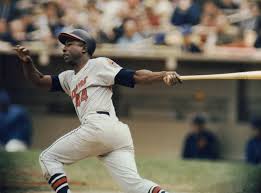
I remember the moment it happened, watching Monday Night Baseball, a long drive off of Al Downing of the LA Dodgers.
How many people saw it live.
It
could have been 100,000. It could have been 200,000.
It is still the
largest home crowd for any home game in Braves history, whether that
game was played in Atlanta, Milwaukee or Boston.
And the crowd that day was a moving picture album of Henry Aaron’s
life. To scan the stadium that day was to scan his years. Herbert Aaron
was there, Henry’s father. Herbert was the first person to hear Henry’s
dreams. It was 1948. Henry was 13 or 14. He went to see Jackie Robinson
speak at the Davis Avenue Recreation Center. Robinson talked about
being relentless, chasing goals, and how a ballplayer’s job is not just
to get hits, it is to score runs.
“I’m going to be in the Major Leagues before Jackie retires,” Henry told his father that day.
His mother Estella was there in the crowd, too. She did not want him
to become a ballplayer, not at the beginning. She wanted him to go to
college, make something of himself, maybe become a teacher. But she also
came to understand that Henry had no room in his imagination for
anything other than baseball. He went to the pool hall instead of
school. He refused to study anything except the art of hitting a
baseball with a bat (or a bottle cap with a broomstick — that was often
the only option). He somehow knew that he was going to be a big-league
ballplayer when that was an impossible thing for him to know.
Ed Scott was there in Atlanta. He was the man who first signed Henry
up to play professional baseball. Aaron was 17 when he joined the Mobile
Black Bears, a semi-pro team made up of grown men — fathers, husbands,
factory workers, farmers.
“He was as green as he could be,” Scott would say in Aaron’s
autobiography “I Had a Hammer.” “He stood up there at the plate upright,
no crouch at all, and the other team figured he wasn’t ready. The
pitcher tried to get a fastball by him, and he hit a line drive that
banged against the old tin fence they had around the outfield out there —
nearly put the ball through the fence. They walked him the rest of the
time.”
John Mullen, the nice man who signed Aaron for the Boston Braves and
watched out for him, was there. Sadly, Mullen’s scout Dewey Griggs was
not. He’d died in 1968. Griggs had seen Aaron play for the Indianapolis
Clowns and was blown away; he told Mullen to do whatever he had to do to
get Aaron signed. But Griggs had an even bigger impact on Aaron’s life.
Before the game, he walked over and said, casually, “You might want to
try hitting with your right hand on top.”
Up to that point, Aaron had been hitting cross-handed.
The first time Aaron hit with his right hand on top of the bat, he homered.
Donald Davidson was there in the crowd that day. He had been the
Braves’ traveling secretary. He had given Aaron his famous uniform
number, No. 44. Aaron had not asked for that number specifically, he’d
only wanted a repeating number for his uniform. “You’re too skinny to
have a double number,” Davidson had said, but then he made sure that
Aaron got the now legendary No. 44.*
*Aaron and another 44, Willie McCovey, hold the baseball record
for most home runs in a season that also matches their uniform number.
Aaron hit 44 homers four times. Davidson would always say his big
mistake was not giving Aaron the number 66.
Davidson was also the one who spread the nickname “Hammerin’ Hank.”
There were celebrities all over the place. Pearl Bailey sang the
National Anthem. Sammy Davis Jr. signed autographs. Georgia governor
Jimmy Carter smiled broadly; that smile was about to become world-famous
— in less than three years, Carter would be elected President of the
United States.
Eddie Matthews was not just there, he was the Atlanta Braves manager. Few teammates
have been as connected as Aaron and Mathews. They were the slugging
brothers for the Milwaukee Braves for a dozen seasons. They were friends
and rivals and balancing influences on each other’s lives. Mathews
brought Aaron out of his shell. Aaron helped Mathews calm down.
“Henry would hit a home run,” their teammate Wes Covington said, “and
— where somebody else would say he got lucky — Mathews would say, ‘What
a shot!’ Mathews would hit a home run, and Hank would say, “Helluva
shot!’ Their relationship was like fourteen-karat gold.”
A band played before the game began. A stockpile of fireworks was set beyond the wall.
And in the second inning of the Braves-Dodgers game, Aaron came up to
the plate to face Al Downing. Words cannot revive the sounds of
Atlanta-Fulton County Stadium in that moment. The cheering was something
more than cheering. Imagine the sound if 53,775 people gathered in one
place to see Neil Armstrong land on the moon or to see the Beatles break
out on the Ed Sullivan Show or to see Mike Eruzione score the goal that
beat the Soviets at the 1980 Olympics.
That’s how it sounded that day. People had not come to see a baseball
game. They had come to be a part of American history, to be in the
photograph when something transcendent and wonderful happened. It isn’t
often in your life that you go to see something that you know — before
it even happens — you will remember forever.
Aaron felt nervous but determined. This would be the day. This would
have to be the day; he couldn’t take it any longer. He waited for
Downing to give him something to hit; the men had faced each other 24
times. They’d each had their victories. Downing had gotten the better of
things the first few times they faced off.
“He usually pitched me outside with sliders and screwballs,” Aaron
would say, and so in 1973, he began to crowd the plate more. That
worked: Aaron cracked a couple of homers off Downing in ’73. He crowded
the plate again that day, and he somehow blocked out the deafening
roars. This was one of his many gifts. “I know it’s hard for people to
believe,” he said. “But I didn’t hear anything when I was at the plate.”
Downing threw a pitch out of the zone. Another. A third. And a
fourth. He walked Aaron on four pitches. The boos from the crowd were
murderous.
Then Dusty Baker, Aaron’s teammate and friend, smacked a drive and
the Dodgers’ left fielder Bill Buckner misplayed the ball. And Aaron
kept running. People never really appreciated just how good a baserunner
Henry Aaron was, but then again, that’s the point of all this. There
were a lot of things about Aaron people never appreciated. He rounded
third and he headed for home. There was no throw to the plate. Aaron
scored the first run of the game.
It was the 2,063rd run of his career.
And that broke the National League record set by Willie Mays.
This was something meaningful, something profoundly important to
Aaron. It went back to the very beginning when he heard Robinson talk
about the importance of scoring runs. To score 2,063 runs you have to
average 100 runs for more than 20 years. It is a mind-numbing
achievement — think about all those cold April nights, those July
steambaths, those meaningless August games and the anxious September
games with a pennant in the balance.
Think about the drive, the focus, the sense of purpose needed to score that many runs.
But nobody did think about that, not there in the crowd that day.
There were no cheers for that record. Everyone was there for something
else, and Aaron knew it. There was no time to celebrate. There was no
time even to breathe. No, there was nothing at all for Henry Aaron to do
except go out the next time and fulfill the destiny he never wanted.
Can a man as beloved and admired and appreciated as Aaron still be
underrated? I think so. It comes down to a simple contradiction: His
name became synonymous with the home run.
“No matter what it is,” Aaron says, “they’re gonna always say, ‘Hank Aaron and a home run, Hank Aaron and a home run.’”
And Hank Aaron was not a home run hitter.
No, Aaron was a pure hitter. He was an excellent outfielder. He was a
superb baserunner. And he was a metronome, pumping out the same
brilliant seasons year after year and decade after decade. He led the
league in total bases eight times, first as a 22-year-old, last at age
35. Eight times. Nobody — not Ruth, not Williams, not Hornsby, not Musial, not Cobb, not anybody — led the league in total bases as many times.
And the home runs? Well, to turn around the phrase, home runs were a
bug, not a feature. Aaron hit the ball very hard and when you hit the
ball very hard, some of them go out. He never hit 70 homers in a season
like Barry Bonds or 65 homers in a season like Mark McGwire or 60 homers
in a season like Babe Ruth or 55 homers in a season like Ken Griffey jr or 50 homers in a season like Mickey Mantle or even 48 homers in a season like Willie Stargell, Dave Kingman and Jorge Soler.
Home runs were not the chorus of Henry Aaron’s song.
He just hit so many baseballs hard over the years that 755 left the ballpark.
And when a person does something as colossal as hit 755 home runs,
it’s hard to think of anything else. The magic inventor and writer Jim
Steinmeyer talks about a type of stagecraft device called the “dazzler.”
It is a very bright light that is placed on stage and pointed at the
audience’s eyes. When that light hits the eyes, everything around the
dazzler seems to disappear. “If there’s something dark near the
dazzler,” he says, “you can’t see it.”
For Henry Aaron, 755 home runs is the dazzler. It blocks the view.
People see that, talk about that, argue about that. (When Bonds hit his
756th home run, people argued about it, raged about it, many insisted
that Bonds would never be the Home Run King, no matter what the record
books said.)
It’s a bright light that blinds people to the things that made Henry
Aaron so special. People can’t see, for instance, how fast Aaron was. He
didn’t steal bases when he was a young player — almost nobody stole
bases in those days, particularly in Milwaukee. In 1957, the Braves
stole 35 bases — we’re talking about the whole team. In 1958, they stole
just 26, dead last in the league.
It wasn’t until 1959 that Aaron started feeling the freedom to steal
bases. He was 25 years old and had been in the league for five years. He
attempted eight stolen bases that year. He was successful all eight
times. From 1959 to 1968, Aaron stole 203 bases, seventh in all of
baseball, ahead even of Mays. He became just the third player in
baseball history to have a 30-30 season.
But here’s the big thing: In those 10 seasons, he was successful on
more than 80 percent of his attempts. That was the highest stolen-base
percentage in the game over that time. How many stolen bases could he
have had if he’d tried? There’s no telling. For his career, Aaron was
successful more than 76 percent of the time, a higher percentage than
Robinson, Maury Wills, Lou Brock, Juan Pierre and, yes, Mays.
“Henry didn’t steal bases like Willie,” Mathews said, “but goddamn,
he could steal bases. He could run like hell, and he didn’t even look
like he was running. I’ll bet you in a footrace, Hank would have beaten
Willie.”
And what about Aaron as an outfielder? Well, he wasn’t a center
fielder (he was actually an infielder when he started) and so
historically he has been written off by many. But by the
Baseball-Reference stats, Aaron was worth 100 runs more than average. By
range factor — number of plays made — he often led the league and
always finished in the top two or three, and, remember, he played just
about his entire career in the same league as another pretty good right
fielder named Roberto Clemente. Aaron won three Gold Gloves and could have won more.
Again, from Mathews: “He never threw to the wrong base, never missed the cutoff man.”
Mostly, though, the dazzler covers up just how complete a hitter
Henry Aaron was. If you took away his 755 home runs — just took them
away — he would still have had 3,000 hits. Not only does he have the
record for most RBIs with 2,297, but he also has the most combined runs
and RBIs.
Most runs plus RBIs:
- Henry Aaron, 4,471
- Babe Ruth, 4,388
- Barry Bonds, 4,223
- Ty Cobb, 4,189
- Alex Rodriguez, 4,107
And then there’s his absurd, almost laughable, breakaway lead in
career total bases. If you want to call Henry Aaron the king of
something, call him the King of Total Bases. He had 6,856 total bases in
his career — 700 more than anyone else.
Musial could have hit 350 more doubles and not had as many total bases as Aaron.
Ruth could have hit 250 more home runs and not has as many total
bases as Aaron. (Bonds would have needed 220 more homers just to tie
Aaron.)
Pete Rose could have cracked another 1,100 singles and not had as many total bases as Aaron.
And let’s add something else that people miss: Aaron played in a
pitcher’s time. He played his prime in a pitcher’s ballpark. If you
neutralize Aaron’s numbers — which is to say you try to put Aaron in
what Baseball-Reference calls a “neutral setting” — Aaron’s numbers jump
from mind-boggling to impossible.
If you neutralize the numbers, Aaron’s total bases jump all the way
to 7,502 — and his lead jumps to almost 1,000 bases. All of his numbers
go up including, yes, home runs (all the way up to 824 neutralized
homers).
See, when you talk about Aaron and home runs, you put Aaron in the
wrong box. He wasn’t a slugger and would not stand up to Ruth or Jimmy Foxx or McGwire or a dozen others as a slugger. He never wanted that. Henry
Aaron was a ballplayer. He hit for average, hit for power, ran the
bases, played good defense and threw with authority. He did everything
well for longer than anyone who ever played this game.
And if he was overshadowed by Mays or Mantle or his blinding
consistency or his laconic persona or, yes, that damned home run chase,
it didn’t matter. He kept going. He kept doing all those brilliant
things. Nothing could make him stop.
“You know,” Aaron once said, “If I had to pay to go see somebody play
for one game, I wouldn’t pay to see Hank Aaron. I wasn’t flashy. I
didn’t start fights. I didn’t rush out to the mound every time a pitch
came near me. I didn’t hustle after fly balls that were 20 rows back in
the seats.”
“But,” he added, “if I had to pay to see someone play in a three-game series, I’d rather see me.”
I asked Henry Aaron if he had any regrets. A career as perfect as his
should be without regrets, at least that’s what you would think. But he
said that he did have one.
He regretted that he never won a triple crown.
“I do think about it,” he said. “I missed it three years — not in a
row, but three years. And I think if I had really concentrated, really
focused on it, I would have won one or two triple crowns.”
Aaron, for the record, won two batting titles, four home run titles
and four RBI titles. But, alas, he never put the three together in one
season.
In 1957, he led the league in homers and RBIs, but his .322 average
was fourth behind three of the greatest hitters who ever lived — Musial,
Mays and Frank Robinson.
In 1959, he led the league in hitting at .355 but his 39 homers and
123 RBIs fell short. He finished seven homers behind his Hall of Fame
teammate Mathews, and finished 20 RBIs shy of Hall of Famer Ernie Banks.
In 1963, he led the league in homers and RBIs, but his .319 average
was seven points behind the Dodgers’ Tommy Davis. He has always
regretted hitting .263 the last two weeks of that season to lose the
batting title.
In 1966, he again led the league in homers and RBIs, but he hit just
.279 that year — he was getting used to a new ballpark in Atlanta and
had shifted his game to take advantage of the home run dimensions.
Of course, what could that matter? What could a triple crown or two add to a career like Aaron’s?
“I just felt … I just felt like there was something missing in my
career,” he said. “I just felt like if I had done what I was supposed to
do, I could have won at least one or two triple crowns. And that just
would have been something …”
He paused here and never finished the thought. I’ve spent a lot of
time thinking about it. I remember years ago, Bob Greene wrote a story
about Frank Gifford and how he’d had pretty much the biggest American
life imaginable — big man on campus at USC, superstar NFL player,
handsome television star, coolest man in the room. But in the end,
Greene found that even Gifford looked back wistfully. In his case,
Gifford wished he could have been the quarterback rather than the
halfback.
This is at the heart of human nature, I guess. I don’t believe anyone
has had a more perfect career than Aaron — perfect in that he never had
a down season and he has several of the most important records. But
even Hank Aaron wishes he could have accomplished just one more
extraordinary thing.
Let’s go back to April 8, 1974. It was the end of the worst time of
Aaron’s life. He had never wanted to chase Babe Ruth’s record. It’s just
that one day, right around when he turned 32, he began to realize that
he had a chance to put up numbers that would match him up with the
greatest to ever play the game. And that was too tempting to pass up.
A writer named Lee Allen explained to him that if he stuck around for
three or four more seasons, he’d have a real shot at 500 home runs. At
that point, only four players ever — Ruth, Foxx, Williams and Mel Ott — had 500 home runs.
And then if he stuck around for another year or two, he’d get to
3,000 hits. That was a big one; only eight players — eight of the
greatest players — had 3,000 hits. Even Ruth and Williams had not done
that.
So he kept doing what he always did, and he hit his 500th homer in
1968. He got 3,000th hit in 1970, but the thing is, that year he began
closing in on 600 homers. So he had to do that. He stuck around in 1971
and led the league in slugging and OPS while bashing 47 home runs. What
was he going to do? Stop there? No, of course not. So he kept going, and
suddenly 700 home runs were in sight, and if 700 homers were in sight,
that meant that Ruth’s unbreakable record of 714 home runs was in sight.
What was he going to do? Stop?
“If I played out my career in typical fashion … the record would show
that I had been one of the best ballplayers to come along,” Aaron wrote
in “I Had a Hammer.” “My credentials would put me in the company of
Ruth and Mays and all the others. But I also knew that in the final
analysis — in the books and sports columns and barbershops — I wouldn’t
be in their class, To be in their class, my numbers had to be better
than theirs. I didn’t agree with it, and I didn’t accept it, but it was
reality, and I had to deal with it.”
And so he dared. He went after Babe Ruth, a black man chasing after a
white legend in 1970s America. He hated every minute of it. He hated
the racist mail that poured in.
“All I do is lay in bed and stare at the ceiling,” he told one reporter who asked how well he slept.
“Well, isn’t it worth it?” he asked.
“I really don’t know,” he said. “If I go to bed half berzerk, it’s not.”
No, he didn’t sleep. He ate every night in his hotel room alone. He
felt alone. Yet he kept on hitting — and hitting home runs — because
somewhere along the way he came to a powerful and painful and undeniable
realization.
The only thing worse than breaking the record would be not breaking the record.
On April 8, 1974, while a misty rain fell, Henry Aaron came up in the
fourth inning. He was the new all-time National League leader in runs.
He stepped in against Al Downing. The crowd stood and cheered madly. He
shut out the sound like only he could do. The first pitch was a slider
and it was down in the dirt.
Then came the next pitch. Downing said it was a fastball up. Aaron
remembered it as a slider down. They both remember Aaron turning on it
and hitting a long and high fly ball to left field. Neither knew it was
gone off the bat. “But,” Downing said, “it kept carrying and carrying.”
When it cleared the fence and landed in the glove of relief pitcher
Tom House, fireworks exploded. The crowd exploded. Aaron’s heart
exploded. He didn’t show it. He rounded the bases the way he always did,
unsmiling, undaunted. He took a moment to shake hands with Dodgers
first baseman Steve Garvey and second baseman Davey Lopes. Even when two
college kids ran on the field and surrounded him — they had run on to
congratulate him — he showed no fear or emotion.
He just kept running.
“What a marvelous moment for baseball,” Vin Scully said
in the booth after letting the crowd tell the story. “What a marvelous
moment for Atlanta and the state of Georgia, what a marvelous moment for
the country and the world. A black man is getting a standing ovation in
the Deep South for breaking the record of an all-time baseball idol.”
So many people have asked Henry Aaron what he was thinking in that
exact moment. I asked him that, too. He shrugged. How do you explain it?
He doesn’t have any better answer now than he did that very day when
the crowd cheered for 11 straight minutes, and his mother raced on the
field and gave him a bear hug that choked the breath out of him, and he
was handed a microphone to say what came to mind now that he had passed
the Babe.
“Thank God it’s over,” he said.