Wednesday, October 28, 2020

LA state of mind


First the Lakers, now the Dodgers, are the Rams next ?

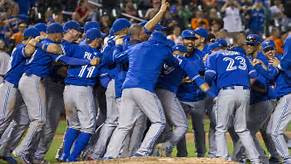
The LA Dodgers won the World Series in 6 games, defeating the Tampa Bay Rays 3-1 in the decisive game last night.

Kevin Cash decided to pull Blake Snell,and the Dodgers were hungry sharks, they smelled blood in the water.

Super reliever Nick Anderson came into relive Blake Snell in the bottom of the 6th inning, leading the Dodgers to a 2 run turnaround lead in the game.


Pete Fairbanks surrendered a sole home run to Mookie Betts in the 8th inning to seal the deal but the secret to this game was not the long ball Dodgers, but the strike out Dodgers.

LA pitching struck out 16 Tampa batters, using 7 Dodger pitchers starting with Tony Gonsolin, ending up with Julio Urias, who fanned 4 in 2 1 rd innings to complete the task.

It has been since 1988, when the Bulldog Orel Hershiser pitched 2 complete game victories on his way to becoming Series MVP.


The one downer was Justin Turner's removal from the game due to a positive Covid test, but one hopes he will recover in time to make the ticker tape parade, or at least a visit to the White House, haha.

Corey Seager won the WS MVP honors after batting .400 and 2 WS home runs.

Well that's it for baseball this year, i certainly hope for Covid free spring training, but I fear we shall have to bubble again, like we did last summer. 🙏


Tuesday, October 20, 2020

It's time. It's fitting. It has come to this. The WS begins tonight.

It’s fitting that the Rays and Dodgers are the ones playing in the 2020 World Series. Not only were they the best regular season teams during this unprecedented year, they’re also model franchises — albeit in very different ways.

At the low end of the payroll spectrum, you have the Rays, a team that ruthlessly trades away established stars and reliably develops new ones. They might not spend much, but from the front office to the coaching staff, this team’s always willing to embrace unconventional methods in a tradition-bound sport. That allows them to get the most out of their considerable talent despite their low budget. And with baseball’s best farm system, they aren’t going anywhere.


At the other end of the payroll spectrum, you have the Dodgers, a team run by longtime Rays executive Andrew Friedman. Thanks to a player development system that churns out stars year after year, the Dodgers have an enviable young core. But unlike the Rays, they can spend big to supplement their homegrown talent, retaining longtime stars like Clayton Kershaw while extending new ones like Mookie Betts. But for all of their resources, the Dodgers aren’t reckless with their prospects or their money. They’ve won their division eight times in a row

Either team would be a deserving champion after playing so well during an adversity-filled season, but of course only one will win the World Series. For the Dodgers, it would be their first championship since 1988. For the Rays, it would be their first in franchise history. Along the way, these questions will be answered on baseball’s biggest stage…

Maybe you’ve heard by now, but Clayton Kershaw has a history of struggling in the playoffs. Okay, you’ve definitely heard. It’s been an ongoing October storyline for much of the last decade, so the consternation surrounding Kershaw’s playoff performance is nothing new.

What’s different is Kershaw now has a chance to change that narrative. Actually, multiple chances. Since Kershaw wasn’t needed in the Dodgers’ Game 7 NLCS win, he lines up to start Game 1 of the World Series. That would also allow him to start Game 5 against the Rays on regular rest and maybe even pitch out of the bullpen on two days’ rest in a potential Game 7.

Regardless of how the first 177.1 innings of Kershaw’s playoff career have unfolded (4.31 ERA, 193 strikeouts), he now has the opportunity to help the Dodgers win their first World Series in his lifetime. For a pitcher who has achieved everything possible on an individual level, a World Series ring is the only thing missing from a resume that’s already worthy of Cooperstown.

With that in mind, the next seven games have higher stakes for Kershaw than for anyone else.

If the playoffs have been a source of frustration for Kershaw, they’ve been the opposite for Randy Arozarena, the breakout star of the 2020 post-season. And where better to continue that emergence than in the World Series?

When the Rays sent minor leaguers Matthew Liberatore and Edgardo Rodriguez to St. Louis for Arozarena, Jose Martinez and a 2020 supplemental first-round pick, it was Martinez who appeared to be the headliner. That was back in January, and less than a year later, it’s already apparent that the Rays have pulled off another heist.

His regular season numbers were impressive enough – seven home runs with a 1.022 OPS in 23 games – but they pale in comparison to his post-season production. In 14 playoff games, the 25-year-old is hitting .382/.433/.855 with seven more home runs, three doubles and a triple.

Really, this looks like best-case scenario for the Rays. Immediate-term, Arozarena is playing his best baseball when it counts the most. And long-term, the Rays can look forward to years of production from a player whose bat appears to be legit.

 Right around the time the Rays were completing a trade for the future ALCS MVP, the Dodgers were contemplating a trade involving the eventual NLCS MVP. According to Ken Rosenthal of The Athletic, Cincinnati, Cleveland and Los Angeles discussed a three-team trade that would have sent Corey Seager to the Reds, Francisco Lindor to the Dodgers and prospects to Cleveland.

Ten months later, the Dodgers must be thrilled that deal didn’t come together. Nothing against Lindor, who had a good-if-not-great year, but Seager was exceptional in the regular season and has been even better in the playoffs (5 HR, 11 RBI, 1.230 OPS in NLCS). Plus, if the Dodgers had acquired Lindor in January, there’s a good chance they wouldn’t have landed Mookie Betts a few weeks later.

Now, Seager’s peaking at the ideal time, and if he can build on his NLCS performance, the Dodgers will be thrilled. But unlike the Rays, the Dodgers are an exceptionally deep offensive team, so there’s no need to focus on a single player. If Seager falters, the likes of Betts, Cody Bellinger, Justin Turner and Will Smith are all capable of being offensive difference makers, too.

 In the afterglow of a World Series title, teams will so often bring back the players who brought them there.


Saturday, October 10, 2020

The end of a cruel summer


It was a poetic showdown, perhaps the inevitable conclusion in this clash of American League East titans who made no secret of their mutual dislike. Aroldis Chapman on the mound and Mike Brosseau at the plate, reprising roles from an incident that cleared the benches a coast away five weeks ago.

That September night in the Bronx, Chapman buzzed a 101 mph fastball over Brosseau, prompting the Rays to warn about their “stable” of elite relievers. Brosseau scored revenge against Chapman on Friday night, connecting for a deciding homer that ended the Yankees’ season with a 2-1 loss in Game 5 of the AL Division Series.

 “I feel terrible,” Chapman said through a translator. “Nobody on our team wants to lose the game. I particularly don’t want to lose. As the closer of this team, that’s my responsibility. It’s tough, but you’ve got to put it aside and keep moving forward.”

 Chapman had been summoned in hopes of recording seven outs, following sharp efforts by Gerrit Cole and Zack Britton. He’d only get four, with Brosseau’s blast coming on the 10th pitch of an at-bat that saw a 100.2 mph heater slugged over Brett Gardner ’s head, reaching the second row of vacant left-field seats at San Diego’s Petco Park.

 Grinding his fist into his glove, Chapman grimaced, again experiencing a turn of events that has grown too familiar for his tastes. One year ago, Chapman watched streamers rain from the roof at Houston’s Minute Maid Park as Jose Altuve rounded the bases for a home run that ended the AL Championship Series and the Yankees’ season. He became the first pitcher in MLB history to allow a go-ahead home run in the eighth inning or later of multiple postseason games with his team facing elimination.

 “That’s tough,” said Cole, who was on the celebratory side of Altuve’s homer. “I could see it in his face when I looked into his eyes. He was able to bounce back from last year, and he’ll bounce back from this series.”

So ends a trying campaign that manager Aaron Boone has described as “heavy,” citing the stresses of playing through a pandemic. Touted in some circles as World Series favorites entering the season, the streaky Yankees never found an answer for the Rays, who bested them in eight of 10 regular-season games before taking the ALDS.

“It’s awful,” Boone said. “The ending is cruel, it really is. There’s so many people I’m grateful for that poured so much into this -- all the players, staff, clubhouse personnel, training staff. Especially in such a crazy year, I’m proud to work alongside so many people who sacrificed so much.”


New York had finished the regular season with a 33-27 record, seven games behind Tampa Bay. As the Rays smoked cigars and celebrated on the field, needling their vanquished opponents by dancing to Frank Sinatra’s “Theme from New York, New York” and the Jay-Z/Alicia Keys collaboration “Empire State of Mind,” the Yankees could only shrug.

The latter tune served as the accompaniment for the Bombers’ 2009 World Series run, coinciding with the opening of the new Stadium. It is a time capsule of an exciting time in the South Bronx and a reminder that the search for a 28th championship title is now at 11 seasons and counting.

Cole’s arrival was supposed to change that, the celebrated right-hander realizing his childhood dream of wearing pinstripes after signing the richest deal ever issued to a free-agent pitcher.

Pitching on short rest for the first time in his professional career, Cole channeled a throwback effort on a night in which the Yankees sported Whitey Ford’s uniform No. 16 on their left sleeves.

 Working around two walks and a hit-by-pitch in a shaky first inning, Cole found his groove. The ace retired eight consecutive batters while receiving support from Aaron Judge’s fourth-inning homer off Nick Anderson.

 “I felt good about holding them down,” said Cole, who faced the Rays five times, including the postseason. “It’s just like on a tape recorder with these guys. It’s tough. They put together a good fight. It sucks losing.”

 Showcasing a fastball that crackled as hot as 100 mph and averaged 98 mph, Cole emptied the tank, retiring 12 of 13 Rays before Austin Meadows launched a deep drive toward right field. Judge attempted a leap at the warning track, banging his head on an overhanging part of the scoreboard as the game-tying drive rattled in the seats.

 “I was right there,” said Judge, who had never played a game in San Diego before this series. “I think I’ve got a shot at any ball that gets hit to right field. That’s a tough one, especially with Cole out there competing his butt off. I’ve got to get up there and rob that one.”

 New York managed only three hits, the last of which came on Aaron Hicks’ sixth-inning single. Luke Voit struck out against Pete Fairbanks in that frame, leaving two men on, and the Yanks produced only one more runner before the lights flicked off on their season.

“To come up short the past couple of years is tough,” Judge said. “Those scars are going to continue to make this team stronger, continue to make this team better. It’s just going to make that World Series title so much sweeter in the end.”


Saturday, October 3, 2020

A legend passes


He’ll be remembered most for that which can’t be measured or even accurately explained. Sure, we have plenty of facts and figures we can use to celebrate the great baseball career of Bob Gibson -- the wins, strikeouts, shutouts, Cy Youngs, Gold Gloves and the World Series superlatives.

But it’s the competitiveness Gibson conveyed and the intimidation he inspired that truly shaped his legacy in this sport. And those are the qualities that we remember most now that he passed away Friday after a battle with pancreatic cancer. He was 84. The Cardinals, the team on which he spent his entire 17-year career, confirmed the news Friday night.

 Gibson's passing comes on the anniversary of one of his greatest games -- his 17-strikeout performance in Game 1 of the World Series on Oct. 2, 1968 -- and less than a month after the death of Lou Brock, a fellow Hall of Famer and Cardinals teammate from 1964-75.

“Bob Gibson was arguably one of the best athletes and among the fiercest competitors to ever play the game of baseball,” said Cardinals’ principle owner and CEO William O. DeWitt, Jr. “With yesterday being the anniversary of his record-setting 17 strikeout World Series game in 1968, it brought back many fond memories of Bob, and his ability to pitch at such a high level when the Cardinals were playing on the games’ biggest stages. Even during the time of his recent illness, Bob remained a strong supporter of the team and remained in contact with members of the organization and several of our players. He will be sorely missed.”

 How does one describe what made Gibson one of the greats? His old teammate Joe Torre was once asked that question.

“Try pride, intensity, talent, respect, dedication,” Torre said. “You need them all.”

 Don Sutton once said Gibson “hated everyone, even Santa Claus.” Gibson’s former catcher Tim McCarver described him as having “eyes smoldering at each batter, almost accusingly.” Dusty Baker once said the only two people he ever felt intimidated by were “Bob Gibson and my daddy,” and when Baker was preparing to face Gibson during Baker’s time with the Braves, Hank Aaron gave him some advice.


“Don’t stare at him, don’t smile at him, don’t talk to him,” Aaron said. “If you happen to hit a home run, don’t run too slow, don’t run too fast. If you happen to want to celebrate, get in the tunnel first.”

 I am crying now as I write this, because I loved Bob Gibson.

Indeed, Gibson was often depicted as the meanest man to ever take the mound, his low-slung cap and crabby countenance pairing with a vicious slider and two variations of a fiery fastball to make for a truly imposing presence. He’s been painted as a bully with the baseball, unafraid to go up and in against any hitter who dared disturb him by inching too close to his precious plate.

Such labels were intended to lionize Gibson for his killer instinct.

But the man himself resented the reputation.

“I wasn’t trying to intimidate anybody, are you kidding me?” he once told Joe Posnanski. “I was just trying to survive, man.”

 Pack Robert Gibson’s tale was one of survival.

Born the youngest of seven children in Omaha, Neb., on Nov. 9, 1935, and named after his father, who died shortly after his birth, Gibson suffered from rickets, asthma and a heart murmur as a child and needed permission from a doctor to compete in sports. That didn’t stop him from becoming a baseball and basketball star at Creighton University, where he was the school’s first African American athlete in either sport.

 How good was Gibson on the hardwood? In 1957, even after signing with the Cardinals to play baseball, he suited up for the splashy, flashy Harlem Globetrotters, a marriage that certainly doesn’t jibe with Gibson’s no-fun, no-frills approach to pitching. But yes, he was quite good, which is why, as the story goes, the Cardinals had to give him an additional $4,000 to persuade him to give up basketball entirely.

Gibson played his earliest professional games in the southern United States at a time when it could not have been easy for a Black man. He endured those ugly experiences, as well as the difficulty of an initial exposure to the big leagues in 1959 and ’60 in which his stuff simply didn’t play up as well as it eventually would. On the mound, Gibson had some wildness that had to be corralled. Off it, he dealt with racial prejudices that affected his role. But by 1962, he began to assert himself as a star on a Cards club that had begun working to ease racial tensions.

 “The initiative in building that spirit,” teammate Curt Flood once wrote, “came from black members of the team. Especially Bob Gibson. … [W]e blacks wanted life to be more pleasant, championships or not. … It began with Gibson and me deliberately kicking over traditional barriers to establish communication. … After breaking bread and pouring a few with us, the others felt better about themselves and us.”

Soon, Gibson and the Cardinals reached the peak of their powers together. Gibson, who came to be known as “Hoot” or “Gibby,” followed up a 19-win season in 1964 by winning Games 5 and 7 in the World Series against the Yankees (the latter on two days’ rest) to claim the Series MVP honor. Three years later, he’d claim that prize again -- this time winning Games 1, 4 and 7 against the Red Sox. All three wins were complete games, as Gibson allowed just 14 hits and five walks while striking out 26, and he even homered in Game 7.

 “[The 1967 Series] was his stage,” teammate Nelson Briles would later say. “He had the worldwide opportunity to display all he was and all that he had. In ’67, that’s exactly what it was for Bob Gibson.”

Gibson and the Cards came out on the wrong end of the result of the 1968 World Series against the Tigers. Gibson again went the distance in Game 7 -- making that his eighth complete game in nine career World Series starts -- but the Tigers prevailed, 4-1.

Still, the 1968 season is remembered as Gibson’s very best. He was the face of the “Year of the Pitcher,” posting a Major League-best 1.12 ERA with 268 strikeouts, 13 shutouts, 15 consecutive winning decisions and a stretch of 95 innings in which he gave up just two runs. He won both the Cy Young and the MVP Award that year, and he led a season so uniquely dominant from the pitching perspective that MLB took the bold step of lowering the mound the following year.


He was simply the best.

Gibson once told the St. Louis Post-Dispatch that he pitched that 1968 season with tremendous pressure.

“I think I developed ulcers then,” he said. “I had a lot of stomach problems and no one ever knew about it. My stomach was always tied in knots because it was always the sixth or seventh inning and the score was 1-0 or 2-1 or something like that, either behind or ahead. And you couldn’t relax. People thought I was relaxed, but I was tied in knots all the time.”

There would be another Cy Young in 1970 and a no-hitter against the Pirates in ’71. Gibson continued a stretch of nine seasons in which he won a Gold Glove, and he was proficient enough at the plate to hit 24 career home runs, plus two in World Series play, and have 30 career games in which he drove in more runs than he allowed. By the time his career ended in ‘75, he had accumulated 251 wins and 3,117 strikeouts with a 2.91 ERA across 3,884 1/3 innings pitched. He was a nine-time All-Star. He was respected enough in his retirement years to serve as a pitching coach for the Mets, Braves and Cardinals. He was a first-ballot Hall of Famer in ‘81 and an obvious choice for MLB"s All Century Team in ‘99.

“Bob Gibson’s intensity and determination commanded respect and admiration from his peers on the field, as well as the generations of baseball fans who followed him throughout his career. His deep love and dedication to the game was felt by everyone he encountered, and nowhere more so than in Cooperstown, where he and his wonderful wife Wendy would return each summer, after his Induction in 1981. On behalf of the Board of Directors and the entire staff of the Hall of Fame, we send our love and deepest condolences to Wendy and the Gibson family. Bob’s spirit will live on forever at the Hall of Fame," Baseball Hall of Fame chairman Janet Forbes Clark said.

 A legend has passed away, a great Cardinal. Rest in peace Bob.

Friday, October 2, 2020

The bough breaks, and the cradle has fallen

Jays lose to the Rays in a best of 3 games, and are out of the 2020 playoffs.
 

When the 2019 baseball season ended and media members gathered at Rogers Centre to hear how the Toronto Blue Jays front office assessed the coming year, the phrase of the day was that it was time for the team to move from “competing to winning.”

General manager Ross Atkins said it repeatedly. President Mark Shapiro said it repeatedly. One began to wonder if that had it written on the palms of their hands.

But, on that very vague score, and in a pandemic-affected quasi-season that was a lousy yardstick for much of anything, mission accomplished. The Blue Jays played 62 games in 2020 and they won 32 of them. It was a definitive step forward, especially for a team that lost 95 games a year earlier, a low watermark they had last touched in 1980.

Beyond that, there’s probably not much sense in trying to assess the greater meaning of the season just completed, for the reason mentioned a couple sentences ago: the goofy sprint of 60 games, which came after an extended layoff that itself came right when players were supposed to be rounding into shape for the season, is no doubt full of statistical noise. The Washington Nationals were 27-33 after 60 games last season and ended up winning the World Series. The Blue Jays were 26-34 after 60 games in the 1989 season, and ended up going to the playoffs, back when only four teams made it to October. It’s tough to draw conclusions from the performance of a team that in any other year would have had 63 per cent of its season left to play.

 But, let’s do it anyway. You don’t have anywhere else to be. (Sigh.)

 The obvious bright spot remains the team’s young core of position players. Cavan BIggio, Lourdes Gurriel, Jr. and Teoscar Hernandez each improved their OPS in 2020 from 2019, the latter by a lot. Bo Bichette looked every bit ready to continue to his path to superstardom before injury cut his already brief season in half. Vladimir Guerrero, Jr., despite a somewhat mystifying lack of power in his two years in the bigs, was in the middle of one of the best stretches of his career, non-Home-Run-Contest division, when the regular season ended. He might have been close to realizing the promise that has been expected of him since he was signed as a teenager. Even Randal Grichuk was justifying the front office’s continued faith in him, with across-the-board offensive improvements over a year earlier.

But, hoo-boy, that pitching. The most striking moment of the playoff series between Tampa and Toronto came when, after Blake Snell had completely befuddled the Jays’ lineup in Game 1, Tyler Glasnow opened Game 2 by striking out Biggio on three pitches, the last of which was a 99-mile-an-hour fastball at the bottom of the strike zone that was just mean. Living rooms across this land were immediately realizing: “Oh, crap, they have ANOTHER of these guys?” Never was the gap between the Rays and Jays more evident than the fact that Tampa has multiple arms of the type that can mow down playoff hitters and Toronto … does not.

 This is something that the Toronto front office vowed it would address last off-season, and Atkins made his first truly aggressive, chips-on-the-table move in four years by acquiring Hyun-Jin Ryu for US$80-million. Depending in your faith in the off-season rumour mill, the Jays also tried to land other high-end starters like Zack Wheeler and Kyle Gibson before settling on Tanner Roark. Ryu was excellent, minus the playoff shellacking, and Roark … was not. He made 11 starts and posted a 6.80 ERA, which was at least better than the 7.22 ERA put up by Chase Anderson, the other veteran that Jays management brought in to try to give some stability to the starting rotation. Matt Shoemaker was strong again when healthy, which unfortunately does not seem to be often, while the various young arms that Atkins and Shapiro were hoping could take starts this season did not do much of that. Nate Pearson, the kid who could be the fireballing ace to head a playoff rotation, had his debut cut short by injury.

And so, whatever the Jays do next year will come back again to that rotation. Pearson has to join Ryu at the top of it if the Blue Jays are going to be any kind of a contender in a normal season. Jays fans have had some dark times over four decades, but a third straight season in which manager Charlie Montoyo is randomly casting about for starting pitchers would be a new one. One of the other Jays’ prospects, Simeon Woods Richardson or Alek Manoah, could even make a Pearson-sized leap to join the big team next year.

But, more likely, it will be up to the front office to again solve the problem that they tried to solve last winter. If the Blue Jays are going to keep moving, from competing to winning to winning a lot, it’s going to be the arms that they don’t yet have at the major-league level that take them there. If there was one good takeaway from that two-game drubbing from Tampa, it’s that the Rays showed them the way.


 The future is bright, but the timing just moved a tick faster.


Friday, September 25, 2020

The Jays make the post season


If the Blue Jays were going to be able to return to the postseason, they were going to need a certifiable ace. Thankfully the front office acknowledged that last winter and managed to get  to agree to a four-year deal to come to Toronto.

Other than a dominate couple of months from David Price back in 2015, the Blue Jays haven’t had a legitimate ace since Roy Halladay was still pitching in their uniform. That’s all changed with Ryu’s presence, and he’s more than proven why the Blue Jays were wise to get him under contract, which now looks like a bargain. He’ll finish the regular season with a 5-2 record with a 2.69 ERA and a 1.15 WHIP, striking out 72 over 67 innings. If for Shane Bieber's ridiculous season in Cleveland, Ryu would likely have a real shot at the AL Cy Young award.

 His value can’t be explained by just looking at his numbers though, and the Blue Jays would be the first to tell you. He provided a tremendous example by shutting down the Yankees on Thursday night, throwing his longest outing of the season and giving the Blue Jays the chance to punch their playoff ticket. That’s what you need out of your number one starter, someone you can turn to in order to win the big games.


 It wasn’t just Thursday night though, as Ryu has also provided a steady presence in the rotation, another trait of a coveted ace. Even when things were rocky with the rest of the rotation, the southpaw picked up the ball every five days and suddenly it felt like the Blue Jays were in control, a feeling that hasn’t been terribly frequent this season despite their overall success.

 If Ross Atkins had a checklist for Ryu in his first year as a Blue Jay, he surely cleared the entire board.

Thankfully the situation hasn’t only been beneficial for the Blue Jays, as Ryu certainly had goals beyond signing a big-dollar deal, although he did just fine with four years and 80 million. That said, he made it clear that he wanted to win, and he saw an opportunity to do just that in Toronto.

 It’s possible that he may be pleasantly surprised with the results in 2020, but this is a team that’s quickly on the rise and Ryu no doubt considered that before making his decision. Fortunately he’s already been rewarded with this first step, and while he never won a championship in L.A. with the Dodgers, he’ll get his first crack at finishing the job as a Blue Jay early next week.

 There is still all kinds of work to do before the Blue Jays will be hoisting a World Series trophy, but thankfully Ryu is helping them move in the right direction, and that’s gotta make all parties very happy.


 Vladdy and Bo to the playoffs, God help the Rays.

Tuesday, September 22, 2020

The man who would be KIng


To tell you the God's honest truth, I didn't think much of him, but boy has my opinion changed.

Welcome to the legend of Alejandro Kirk . He’s here, he’s real and he just had his coming out party against the New York Yankees.

Kirk is one of the most unique players in Major League Baseball, regardless of whether you’re looking at your TV screen or the box score. In the box, the 5-foot-8, 265-pound Kirk barely has a height advantage over the catcher crouching behind him. On the bases, he makes Vladimir Guerrero Jr. look like Usain Bolt. Alejandro Kirk is not what you’d expect, and that’s what makes him special.

 In Monday night’s 11-5 win over the Yankees in Buffalo, N.Y., Kirk was already 3-for-3 with a double and a near miss for his first career home run when he stepped to the plate in the seventh. This time he didn’t miss. Kirk launched it to the opposite field again, but this one had the legs, carrying over the wall for Toronto’s 11th run and sending the dugout into a frenzy.

 “To be honest with you, I didn’t think it was going to be out,” Kirk, a native of Mexico, said through a club translator. “But then I saw Judge going back, back. In that moment, when he hit the fence, I knew it. It was great. The feeling of running around the bases was great. It’s still good, even right now.”


Kirk doesn’t just have fans in Canada, either. His teammates, nearly all of whom are playing alongside him for the very first time, have embraced Kirk, and nights like this one only make it easier.

“It can’t get any better for me,” Kirk said. “They welcomed me. All of the guys are great with me since I got here and they all talk with me. Little by little, we’re getting to know each other better and I’m trying to communicate with them a little bit more. I can’t ask for more from the guys.”

Monday’s performance made Kirk the first catcher age 21 or younger to record a four-hit game since the Twins' Joe Mauer in 2004. Along with Guerrero Jr., who went 3-for-3 with three RBIs, the two became just the second pair of teammates aged 21 or younger in the modern era to have three-plus hits and two-plus extra-base hits in the same game, joining Hall of Famers Ted Williams and Bobby Doerr of the Red Sox in 1939.

 Kirk is a natural, which is a word we throw around loosely at times, but he embodies the idea completely. He doesn’t have the raw physical tools of so many other players on this roster, but watching Kirk in the Minor Leagues and now with the Blue Jays, the game seems to unfold just a bit slower for him. That’s why he’s handled the jump from Class A Advanced Dunedin to the big leagues without blinking an eye.

Kirk’s offensive value is a simple combination of two factors, and it begins with his approach, which is one of the best in the organization. Over 151 career games in the Minors, Kirk walked 89 times but struck out just 60. That’s good for a .418 on-base percentage, making him an incredibly reliable plate appearance for such a young hitter. What that all sets up, though, is the other piece to the puzzle, which is Kirk’s habit of lighting up Statcast with hard contact.

 Kirk ripped his two singles in the series opener at 106.6 mph and 104.6 mph, the latter of which hit off the top of the right-field wall. Entering Monday, a whopping five of the nine balls Kirk had put in play were hit harder than 100 mph. No, Kirk won’t beat out any infield singles, but he doesn’t need to.


It’s also important to note just how strongly the Blue Jays' front office feels about Kirk’s work behind the plate. Upper management believes he belongs there, and so does manager Charlie Montoyo.

 “He’s done a great job receiving. I’m impressed with that,” Montoyo said. “Blocking balls, too, he’s been really good. I’m impressed with his overall game, to tell you the truth.”

Danny Jansen remains the starter behind the plate, but the Blue Jays need Kirk’s bat in the lineup. Tasking a 21-year-old old with handling a new pitching staff in the club’s first postseason appearance since 2016 would be a big ask, but the DH spot seems like a perfect home for Kirk in these coming weeks. He’s also a great option to bring off the bench, if that situation arises, given how reliably he puts the ball in play without creating empty outs.

 Entering play on Monday, the Blue Jays were getting a .271 average and an .807 OPS from their DH spot, so it hasn’t been a black hole by any means, but much of that is the product of Guerrero Jr. and other players who have cycled through. Barring a surprise return from the injured Rowdy Tellez, the door is suddenly wide open for Kirk to come out of nowhere and play an everyday role in the postseason.

Get ready Tampa, you just might get a visit from the King.